
Supplemental Claim vs. Higher-Level Review: VA Appeals Compared (2026)
The short version: Got a denial letter? Three questions help sort most cases — treat them as a starting framework, not a final answer: (1) Do you have new and relevant evidence the VA hasn't seen? → Supplemental Claim (VA Form 20-0995). (2) Is the record complete but you believe the VA misread it? → Higher-Level Review (VA Form 20-0996). (3) Do you want a judge? → Board Appeal (VA Form 10182). A veteran can have more than one valid review option, and the choice affects timing, what evidence can be developed, and procedural strategy — so use the framework below, then confirm the lane with an accredited representative. Picking the wrong lane costs you months: new evidence can't be added in an HLR, and a Supplemental Claim without new evidence goes nowhere.
What the road actually looks like
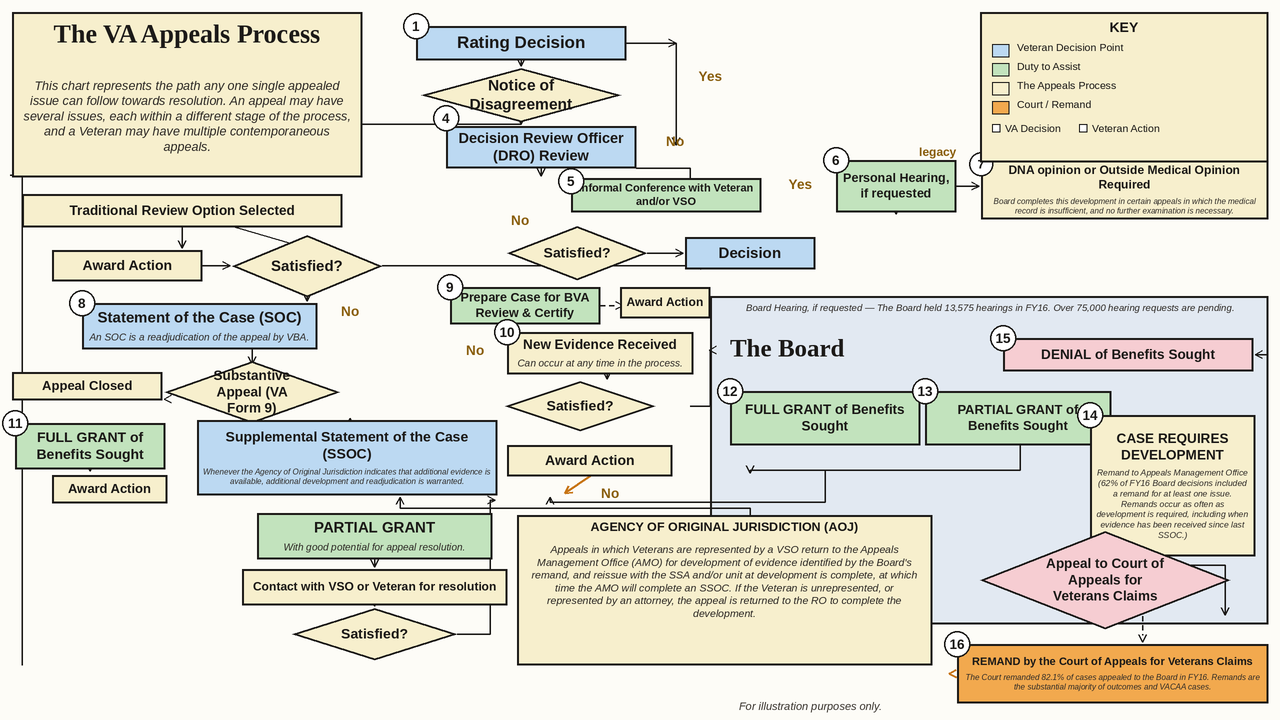
Before the lanes, look at the road itself. This is the VA appeals process drawn out in full — every lane, loop, and off-ramp a denied claim can take. It is supposed to look tangled: that tangle is exactly why the choice of lane matters, and why the three questions below are worth answering before you file anything.
The three lanes
| Supplemental Claim | Higher-Level Review | Board Appeal | |
|---|---|---|---|
| Form | VA Form 20-0995 | VA Form 20-0996 | VA Form 10182 |
| New evidence? | Required — "new and relevant": information the VA hasn't considered before that proves or disproves something in your claim | Not allowed — same record, reviewed by a higher-level reviewer | Depends on docket (Direct Review: no; Evidence Submission: yes, with appeal or within 90 days; Hearing: yes, at hearing or within 90 days after) |
| What it fixes | The file was missing something you can now supply (nexus opinion, buddy statement, records VA never had) | The file was complete but the decision misread it — the reviewer determines whether an error or a difference of opinion changes the decision; also catches "duty-to-assist errors" (VA failed to gather evidence it should have) | You want a Veterans Law Judge to decide |
| Can it follow... | Any past decision (also the path when a law changed, e.g. PACT Act presumptives) | An initial or Supplemental Claim decision — not a prior HLR or Board decision on the same issue | The other lanes' decisions |
| Deadline | File any time; within 1 year of the decision letter to preserve your effective date | Within 1 year of the decision on your initial or Supplemental Claim (clock starts at the decision-letter date) | Generally within 1 year (60 days for simultaneously contested claims) |
| VA timeliness goal | 125-day goal (58.3-day average for disability compensation/pension, Sept 2026) | Goal: 125-day average (4–5 months); an informal conference may lengthen it | Docket-dependent goals: Direct Review 365 days; Evidence Submission 550 days; Hearing 730 days |
| Reviewer | VA reviewer, on the updated record | Higher-level reviewer, on the same record | Veterans Law Judge |
| Optional conference | No | Informal conference — one optional call with the reviewer to point out errors (can lengthen the decision; not a hearing; no new evidence) | Hearing docket only |
Sources: va.gov/decision-reviews/ · va.gov/decision-reviews/supplemental-claim/ · va.gov/decision-reviews/higher-level-review/ · va.gov/decision-reviews/board-appeal/. The timeliness figures are VA's published processing goals, not guaranteed decision times — actual completion times vary by case type and workload.
The 3-question decision tree
Use this as a starting framework, not a final answer — the notes on each question explain where the edges are.
- Do you have new and relevant evidence the VA has never seen? (New medical opinion, diagnosis, buddy statement, service records the VA didn't have.) → Supplemental Claim. It can follow any decision, and the VA will help you gather evidence you identify.
- No new evidence — but the VA got the existing record wrong? (Overlooked favorable document, misapplied rating criteria, wrong effective date despite a documented intent-to-file, a possible duty-to-assist error like a missed exam.) → Higher-Level Review. A senior reviewer re-reads the exact same file. Take the informal conference and point to the specific errors.
- Want a judge, want to add evidence at the Board, or want a hearing? → Board Appeal. Pick your docket deliberately — Direct Review is the fastest but takes no new evidence; Evidence Submission and Hearing let you add evidence within 90-day windows but take substantially longer.
The trap to avoid: submitting new evidence with a Higher-Level Review. The VA will not consider it in that lane — you'll burn months and end up filing a Supplemental Claim anyway. If you're unsure which lane fits and you can develop new evidence, a Supplemental Claim is often the safer starting point — but confirm with an accredited representative before filing; the wrong lane costs months.
The effective-date rule: filing a review option within 1 year of the decision keeps the issue continuously pursued, which preserves the potential for your original effective date — the difference between years of back pay and a new, later date. It does not guarantee the original date: other rules (including 38 C.F.R. § 3.400) still apply. A Supplemental Claim received more than one year after the decision notice generally gets an effective date no earlier than the date VA receives it — but statutory exceptions exist, including a good-cause extension. Your decision letter states your deadline; trust it over any website, including this one.
When an HLR catches a duty-to-assist error
This is the HLR outcome most veterans don't expect. You can't submit new evidence in a Higher-Level Review — but the reviewer can find that VA itself failed to get evidence it should have gathered. VA calls this a "duty-to-assist error": a missed C&P exam, service or medical records VA never requested, development steps VA skipped. When the reviewer finds one, VA lists the steps needed to fix the error, gathers the missing evidence, and decides the case on the fuller record.
Why it matters: it's one of the only ways the evidentiary record effectively grows inside an HLR. If your denial letter hints VA never obtained records you identified, or no exam was ever scheduled, an HLR asking the reviewer to check for a duty-to-assist error can be worth more than it looks — and the informal conference is the place to point at the gap.
Fact vs. commentary
FACT (primary sources):
- Supplemental Claim requires "new and relevant" evidence unless the claim is based on a change in law; "new" = not previously considered, "relevant" = proves or disproves something in the claim.
- Higher-Level Review cannot be requested after a previous HLR or Board decision on the same issue, and is unavailable for contested claims.
- If the HLR reviewer finds a "duty-to-assist error," the VA fixes the error, gathers the evidence, and decides on the new record.
- If your rated condition got worse, do not file a Supplemental Claim — file a claim for increased disability compensation.
- Board Appeal dockets: Direct Review (no new evidence, no hearing, 365-day goal); Evidence Submission (new evidence with the appeal or within 90 days, 550-day goal); Hearing (new evidence at the hearing or within 90 days after, 730-day goal).
- Filing a review option within 1 year keeps the issue continuously pursued, preserving the potential original effective date — subject to 38 C.F.R. § 3.400 and other provisions, not a guarantee.
COMMENTARY / OPINION (clearly labeled):
- Opinion: As a practical starting point, many veterans find the Supplemental Claim the more forgiving lane when they can develop new evidence — HLR rewards a precise, page-specific error argument. If you find yourself writing a 10-page argument about why the rater was wrong and attaching new records, the records point toward a Supplemental Claim — but confirm the lane with an accredited representative before filing.
- Opinion: Take the informal conference in an HLR only if you can point to specific errors on the page. A conference to "explain your whole case" to a reviewer who can't consider new evidence is usually time wasted.
Worked examples
Denied for sleep apnea secondary to PTSD. The denial says: "No medical evidence of a nexus between the veteran's PTSD and sleep apnea." Your file has no medical opinion connecting them. → Likely Supplemental Claim, attaching a nexus opinion (a medical opinion stating "at least as likely as not" that the PTSD caused or aggravated the sleep apnea). But don't rule out HLR on those facts alone — if the record also shows a reviewable error (the rater overlooked an existing diagnosis, or VA failed to obtain evidence it should have gathered), an HLR could still be the right lane. When the file suggests both paths, get an accredited representative's read before choosing.
Denied effective date. The record shows a documented Intent to File dated 6 months before the claim, but the VA set the effective date at the claim date. The file is complete; the application of the rule is wrong. → Higher-Level Review with an informal conference, pointing at the ITF in the record.
Related on The VA Files: VA disability calculator — estimate your combined rating · Veteran resources — official VA links and free guides
Get the free VA Files Briefing
New guides and resources by email. Free, no card, unsubscribe anytime.
Join Free