
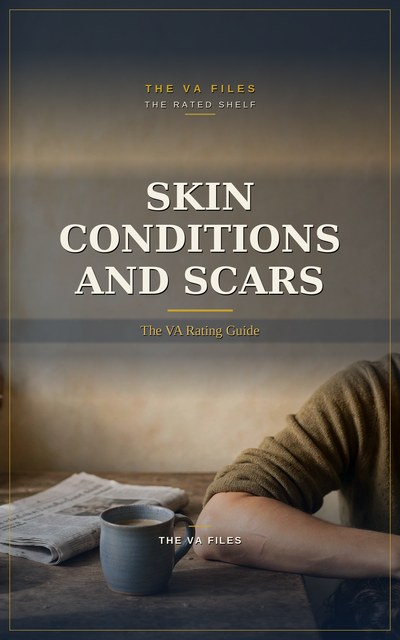
Skin Conditions and Scars: The VA Rating Guide
The VA Rating Guide
About this guide
This book is education, not representation and not medical advice. It teaches how VA rates skin conditions and scars under 38 CFR § 4.118, Schedule of ratings — skin — a section that is really two schedules sharing one number. The first is a formula: most diseases of the skin rate by how much of the body they cover and by what it takes to treat them. The second is a set of measurements: scars rate by where they sit, how large they are, what they have done to the tissue underneath, and whether they hurt or keep breaking open — and a veteran can live in both halves at once, eczema on the formula side and the surgical scar that came with service on the measurement side. The book prints the section's two governing paragraphs in the regulation's own words and reads them the way a rater has to: paragraph (a) draws the section's most valuable line with a route test, not a drug test — treatment that reaches you through any route other than the skin is systemic, treatment through the skin is topical, and how strong the cream is does not move it across the line — and paragraph (b) is the combining rule, under which two skin conditions price together only when they occupy separate areas and only the highest evaluation is used over the same area. It prints the General Rating Formula word for word, the five scar codes with every note, and the named diseases veterans actually claim, then takes apart the words that decide files — the eight characteristics of disfigurement, underlying soft tissue damage, unstable, and the topical–systemic line where, since 2018, the money in the formula half is won and lost. It walks the doors into service connection, including the scar that arrives as the residue of a service-connected surgery and the skin diseases on the herbicide presumption list that carry their own one-year fence, works what happens when skin ratings meet — the same-area rule and the notes that let a scar's separate effects be priced separately — dismantles the traps, including two diagnostic-code numbers the internet routinely gets wrong, walks VA's two exam forms section by section (which one a file gets depends on which half of the schedule it is in), and works three complete files. No dollar amounts appear anywhere, by design: pay tables change with each cost-of-living adjustment and live at va.gov. Every rule was checked against its primary source — the current regulation read word for word, VA's own exam forms read page by page, and the statute where the statute is the authority — and the Sources & Verification page lists them all.
Free with a Briefing membership — your 1 monthly credit covers this book. No card to join.
What’s inside
- Chapter 1 — The Schedule in Full
- Chapter 2 — The Words That Decide Files
- Chapter 3 — The Doors In — How Skin Conditions and Scars Get Service Connected
- Chapter 4 — When Skin Ratings Meet — Combining, Stacking, and the Same-Area Rule
- Chapter 5 — Traps
- Chapter 6 — Exam Day — The Two DBQs, Section by Section
- Chapter 7 — Three Files
- Chapter 8 — If VA Gets It Wrong
- Closing Page
- Sources & Verification
This guide + 610 titles more with membership
Members unlock books with book credits — and every book you unlock is yours to keep.
🔒 Unlock · 1 credit ($5.00) or $9.99 — save $4.99Membership — the whole library
Briefing — Free. 1 book credit every month. No card to join.
Join free Briefing — Free. 1 book credit every month. No card to join.
Mission — $3.99/month (about 13¢ a day). 6 book credits when you join, +4 every renewal.
Join Mission Join Command Mission — $3.99/month (about 13¢ a day). 6 book credits when you join, +4 every renewal.
 Command — $7.99/month (about 27¢ a day). 12 book credits when you join, +9 every renewal.

Billed monthly. Cancel anytime — you keep every book you’ve unlocked. Yours to keep. Credits you buy never expire.
What one rating step can be worth: VA’s official 2026 compensation rates (effective December 1, 2025), for a veteran alone with no dependents, pay $2,362.30/month at 90% and $3,938.58/month at 100%. The difference is $1,576.28/month.
Buy it once. It stays yours.
Fixes and expansions are free for books you own. New books and new editions are separate.
If you’re in crisis, call or text 988 and press 1 — the Veterans Crisis Line is free, confidential, and answered 24/7. In an emergency, dial 911.
The VA Files is an education library and peer navigation service, run by a veteran — not the VA, not a law firm, not a medical provider. We teach, You learn. You file. The VA decides. We review together. If it’s not what you deserve, you appeal, add evidence, and stay in the fight until it’s right.
‹ Back to the library